
Part One of a Two-Part Series
The Invisible Drivers Beneath the Surface
You know the story. The client who’s done it all. Therapy, breathwork, supplements, mobility drills, mindset coaching, and still keeps looping. Symptoms return, old compensations resurface, and progress feels… fragile.
You tweak the protocol, try a different strategy, but something’s not adding up. It’s not just their mindset. Not just their fascia. And no, it’s not that they “don’t want it bad enough.”
What if the problem isn’t in what they’re doing…
but in what’s running the show underneath?
Primitive Reflexes: The System’s Hidden Operating Code
Primitive reflexes — those involuntary movements we associate with infants, aren’t just pediatric leftovers. They’re part of your client’s baseline operating system. They’re wired in before birth, kick in during early survival, and ideally inhibit as the cortex matures.
But they never uninstall. They stay dormant. Waiting.
When the nervous system perceives significant threat — trauma, infection, concussion, chronic stress — these reflexes don’t whisper. They flip on. And suddenly, your client is moving, breathing, and reacting through a brainstem-dominated program written decades ago.
They’ve booted into “safe mode.” And they don’t even know it.
What Safe Mode Looks Like in Adults
Think about how a computer behaves in safe mode: stripped-down function, no multitasking, no finesse. Just basic survival operations. That’s what the nervous system does with retained reflexes.
You’ve seen it:
-
The athlete post-concussion who keeps getting injured.
-
The anxious client whose chest collapses with every inhale.
-
The chronically sore adult whose breathing is reversed — rib cage up, spine locked, extensors fried.
Their body isn’t failing. It’s protecting.
It’s running the code it knows.
Why Most Practitioners Miss This
...And What Makes Functional NeuroHealth™ Different
Most approaches to retained reflexes fall short because they treat the output, the movement, posture, or symptom, instead of decoding the loop itself.
The traditional model?
-
Stim the reflex, see what happens.
-
Do drills or movement games to override it.
-
Repeat for weeks. Maybe months.
-
Hope it works.
That’s not what we do.
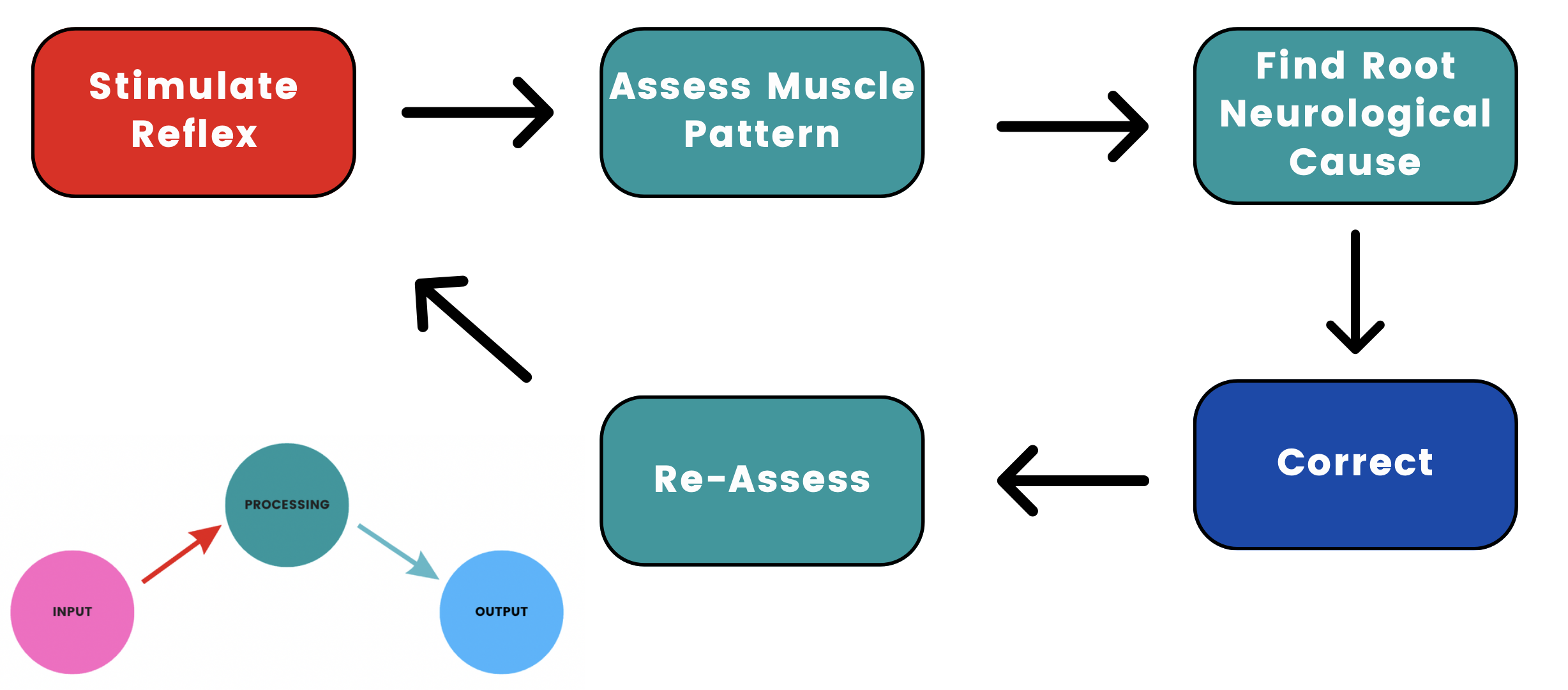
In Functional NeuroHealth™, reflexes are treated as complete neurological loops. Each with a specific input, processing center, and output. And our method is designed to find the faulty step fast, then correct it instantly.
Instead of 10–20 sessions integrating one reflex...
We can integrate multiple reflexes in one session.
Sometimes in seconds. Because the reflexes aren’t slow — the system is just misunderstood.
Here’s how we do it:
-
Functional History + Pattern Recognition
We start by identifying clinical clues from breathing, postural tone, and compensation patterns. -
Muscle Testing — but differently
Not “strength testing.” We use indicator muscles as neurological proxies to assess inhibition patterns tied to reflex activation. -
Layered Reflex Assessment
We test whether the reflex is stuck because of:-
Afferent issues (input or injury signals)
-
Efferent issues (brain processing via pons, limbic, cortex)
-
Or hidden global lockout switches like Tendon Guard Reflex
-
-
Reflex Correction via the Right Pathway
-
Afferent corrections: primal movements, injury signal resets, mechanoreceptor reprogramming
-
Efferent corrections: brain point holds, tuning forks, rocking, intentional calibration
-
Sensory reinforcements if deeper reflex layers are present
-
-
Re-assess
If the loop clears, tone normalises instantly. If not, we go deeper.
This isn’t another “tool". It’s a framework.
And when you know where the error is, you can flip the switch in real time.
Reflexes Are the Foundation, Not a Side Quest
Let’s zoom out.
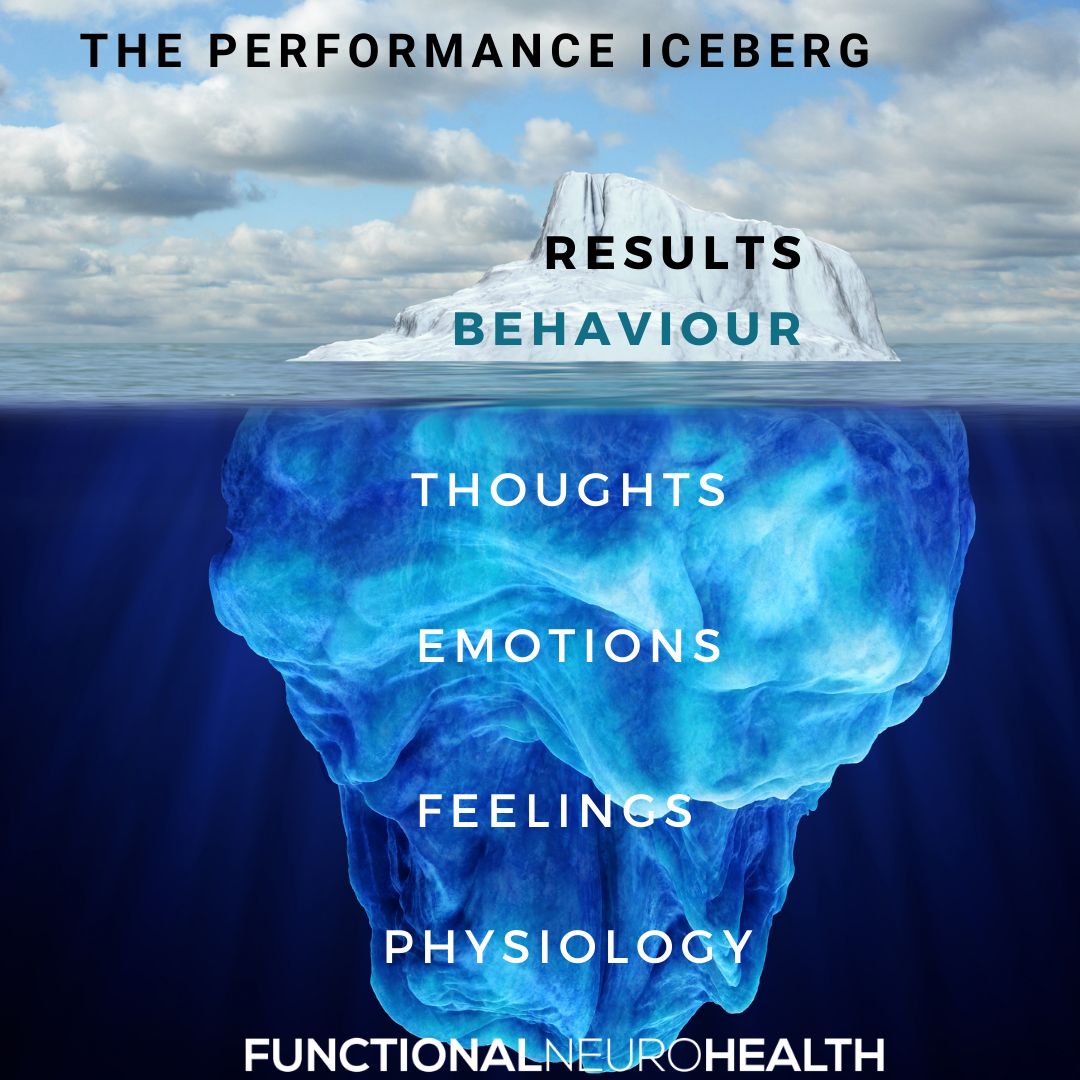
The Iceberg Model
Above the surface: behavior, results, symptoms.
Below the surface: thoughts → emotions → physiology.
Under it all: reflexes. If they’re still active, everything above them is distorted.
The Threshold Model
At baseline: system feels safe → adaptive function.
When under threat: system crosses threshold → brainstem takes over.
Reflexes are the master switches that determine which side of the threshold your client lives on.
In FNH, we don’t guess which switch is faulty — we test, target, and reset it.
⚡ Case Studies from the Field
1. Chronic Lower Back Pain
Clients with stubborn back pain often see instant relief when exhalation-focused breathing resets flexion–extension mechanics. Why? Because retained Moro/startle reflexes can invert breath patterns, loading extensor tone. With the right correction, pain drops in minutes.
2. Anxiety & Faulty Breathing
A client stuck in an anxiety loop wasn’t calmed by therapy or breathwork. Why? Because the reflex behind their breathing mechanics was still active. One correction to the reflex pathway, and their system shifted.
3. PTSD Freeze Response
A woman with complex PTSD was stuck in a fear paralysis loop. One session of our method — identifying the right input and clearing the code — and her system relaxed. Her psychotherapist immediately noticed the change and began referring clients. The shift wasn’t subtle. It was neurological.
🔒 Subscriber-Only Deep Dive
Behind the Reflex: Layered Insight & Clinical Leverage
You’re inside the paywall — so here’s where we go deeper.
How to Spot a Reflex Stack in Adults
Most adults don’t have just one retained reflex — they have a cluster. And if you only treat the obvious one, the deeper drivers remain.
Here’s what to look for:
| Pattern | Likely Reflex Stack |
|---|---|
| Shallow chest breathing + extensor tone overload | Moro + Fear Paralysis |
| One-sided neck/eye tension + shoulder instability | ATNR + Palmar |
| Chronic flinching or tight glutes + scoliosis | TGR + Galant |
| Freeze/dissociate + light/sound aversion | Fear Paralysis + Cranial Nerve involvement |
Clinical Tip:
When breath, tone, and eyes all feel “off,” suspect a Track 1 + Track 2 stack — and start with the highest priority reflex. If you don't know how to do this, this one of the many ingenious hacks I teach in my programs.
Muscle Testing = Neurological Mirror
Inside FNH, muscle testing isn’t about strength — it’s how we read real-time brainstem output.
Step-by-step:
-
Choose a clear indicator (e.g., deltoid or glute med).
-
Test in neutral. If it inhibits, something’s driving reflexive override.
-
Apply one correction (tuning fork, intention hold, injury release).
-
Retest.
If the muscle switches on immediately — the reflex loop has cleared. If not, the issue lies deeper in input or processing.
This is precision work. You’re not throwing drills at the problem — you’re asking the system what it needs, and watching it answer.
Track 1 vs Track 2: The Reflex Map
Track 1 (Saggital, More primal/threat loops):
Moro, Fear Paralysis, TGR, Galant, STNR
Track 2 (Unillateral, Gait Based):
ATNR, Palmar, Plantar, Rooting, Suck
The highest priority reflex in each track acts like a fuse box. Correct it, and the rest often switch off with it.
We teach how to assess and target these reflex priorities inside Primitive Reflex Mastery. But even here, you can start watching for cluster patterns and asking: Which track is primary?
Real-World Case: 95% Pain Resolution in 7-Year Chronic Case
FNH-trained practitioner Alyssa worked with a client suffering chronic musculoskeletal pain for over 7 years. They’d tried:
-
Chiro
-
Dry needling
-
Strength rehab
-
Pain psychology
-
Myofascial release
Pain would reduce temporarily — then snap back.
What changed?
Alyssa applied the FNH Reflex and Cranial Nerve approach. She didn’t treat the tissue. She didn’t prescribe exercises. She just:
-
Identified retained reflex patterns via muscle inhibition and postural mapping
-
Tracked the issue to Cranial Nerve input dysfunction + retained Primitive Reflexes.
-
Corrected through input–processing loop resets
In just 2 sessions, the client had 95% symptom resolution. No flare-ups since.
Why?
Because the pain wasn’t structural. It was neurological. And once the master switch flipped, the entire body reorganized.
🔚 Translation to Your Clinic
-
That “complicated” client may just be running outdated code.
-
The tissue might be fine — but the reflex layer is still active.
-
Pain, behavior, and posture are just output. You change output by correcting the right input–processing loop.
You now have the map.
Why This System Sticks
(When Others Don’t)
Most systems try to hammer a reflex off with repetition. But that’s not how reflexes work
In FNH, we treat reflexes as neurological loops — not muscles, not behaviours.
-
Input: What’s triggering the system?
-
Processing: How is the brainstem integrating it?
-
Output: What movement or autonomic response results?
Correct the right layer, and the output shifts immediately.
That’s why our practitioners can make lasting changes in minutes — and replicate them across clients, day after day.
You don’t need another modality. You need the map.
The High-Performer Paradox
Reflexes don’t just hijack development. They hijack performance:
-
Concussed athletes: flung arms, curled hands — visible Moro and Palmar activation.
-
Driven entrepreneurs: nonstop vigilance from an overactive Moro reflex.
-
Chronic pain clients: gait and postural dysfunction driven by retained ATNR or Spinal Galant patterns.
These aren’t personality traits or compensations.
They’re outdated reflexes running the show.
Why This Changes Everything
Whether you're a physio, osteo, kinesiologist, coach, or therapist, reflex integration isn’t a niche.
It’s the foundation that makes everything else work better.
-
It explains why some clients relapse after solid care.
-
It bridges physical, emotional, and behavioral symptoms in one system.
-
It lets you treat the cause — not just the expression.
Want to Learn This? Here's How:
We teach this full framework in Primitive Reflex Mastery — our deep-dive course for practitioners ready to unlock their next-level clinical power.
Inside, you’ll learn how to:
✅ Identify retained reflexes in adults, even without visual signs
✅ Run layered assessments (input vs processing vs output)
✅ Use our unique neurological muscle testing framework
✅ Correct reflexes in-session, without lengthy protocols
✅ Integrate sensory and primal movement reinforcement
🧠 Think: Instant reflex resets. No guesswork. No gimmicks. Just repeatable neuro results.
💡Investment: $1950 for access to this speciality program
📲 To learn more, reply with “REFLEX”
Prefer a guided intro?
Join the Foundations Program — our most accessible pathway into the full FNH system, including:
✅ Primitive Reflexes
✅ Vagus & breath testing
✅ Muscle testing framework
✅ Weekly live mentoring
📌 $97/week | 🆓 First week free | Cancel anytime
[→ Click here to join Foundations]
Parting Thought: See the Code
Most practitioners spend years unknowingly treating around retained reflexes. Once you see them, you realize they’ve been there all along — shaping posture, performance, pain, and progress.
Reflexes are the nervous system’s master switches.
Reset them, and the whole system shifts.
And once you see the code...
You can’t unsee it.
🔄 We Want Your Input
You’re part of the Neurology Edge community, and this newsletter is designed to serve you at the highest level.
👉 What do you want more of?
-
More case study breakdowns?
-
Different topics?
-
Clinical gems from other practitioners in the FNH system?
Hit reply to this email and let us know. We read every response.
👀 Coming Next: Track 1 Reflexes
In the next issue, we’ll dive into the Track 1 Reflexes — Fear Paralysis, Moro, Startle, STNR, and Galant.
-
Their specific functions in human development
-
The causes that keep them active in adults
-
Why correcting the priority reflex in Track 1 often clears the entire cluster
This is where reflex work gets really powerful — because Track 1 reflexes are the master switches of safety and survival.
Stay tuned. You won’t want to miss it.

Responses