
In over 12 years of muscle testing and 17 years of working with clients, I can say this with confidence:
👉 The psoas is the most commonly dysfunctional muscle I’ve ever tested.
It shows up in almost every chronic case. People stretch it, foam roll it, try to “release” it — yet it remains misunderstood. Some call it the “fight-or-flight muscle.” Others, more poetically, the “muscle of the soul.” Both names hint at its deeper significance. But what I want to show you here is how the psoas fits into the neurological operating system of the body.
When you see it through this lens, the psoas stops being just a “tight hip flexor” and becomes something far more interesting: a signal of safety or threat in the nervous system.
Anatomy: The Only Muscle Connecting Spine to Leg
Let’s start with its basic form.
The psoas major originates from the sides of the lumbar vertebrae (T12–L4/5) and their discs, runs through the pelvis, and inserts onto the lesser trochanter of the femur. This makes it the only muscle in the body that directly links the spine to the legs.
Its functions go far beyond hip flexion:
-
Hip flexor: lifting the thigh toward the torso.
-
Lumbar stabiliser: acting like a guy-wire balancing the lumbar spine from the front.
-
Spinal lateral flexor: when acting unilaterally.
-
Rotator and adductor: depending on joint position.
When both sides fire together, the psoas is not simply moving us — it’s holding us upright. In standing and sitting, the psoas and spinal extensors form a suspension system around the lumbar spine. Lose psoas integrity, and the spine loses stability.
This is why imaging studies show that chronic low back pain sufferers often present with atrophied or inhibited psoas muscles on the painful side. The system literally down-regulates the muscle, leaving the back exposed.
Neurological Context: Why Inhibition Matters More Than Tightness
Here’s the paradox:
Most people feel their psoas as “tight.” But clinically, in testing, I find it is more often inhibited/under-facilitated — neurologically switched down, unable to activate properly.
A muscle can be ropey and stiff from chronic guarding, yet when you test it, it fails. The brain has effectively “turned down the volume” because it doesn’t feel safe recruiting it.
Why?
-
Reciprocal inhibition: antagonists (like glutes or hamstrings) over-fire.
-
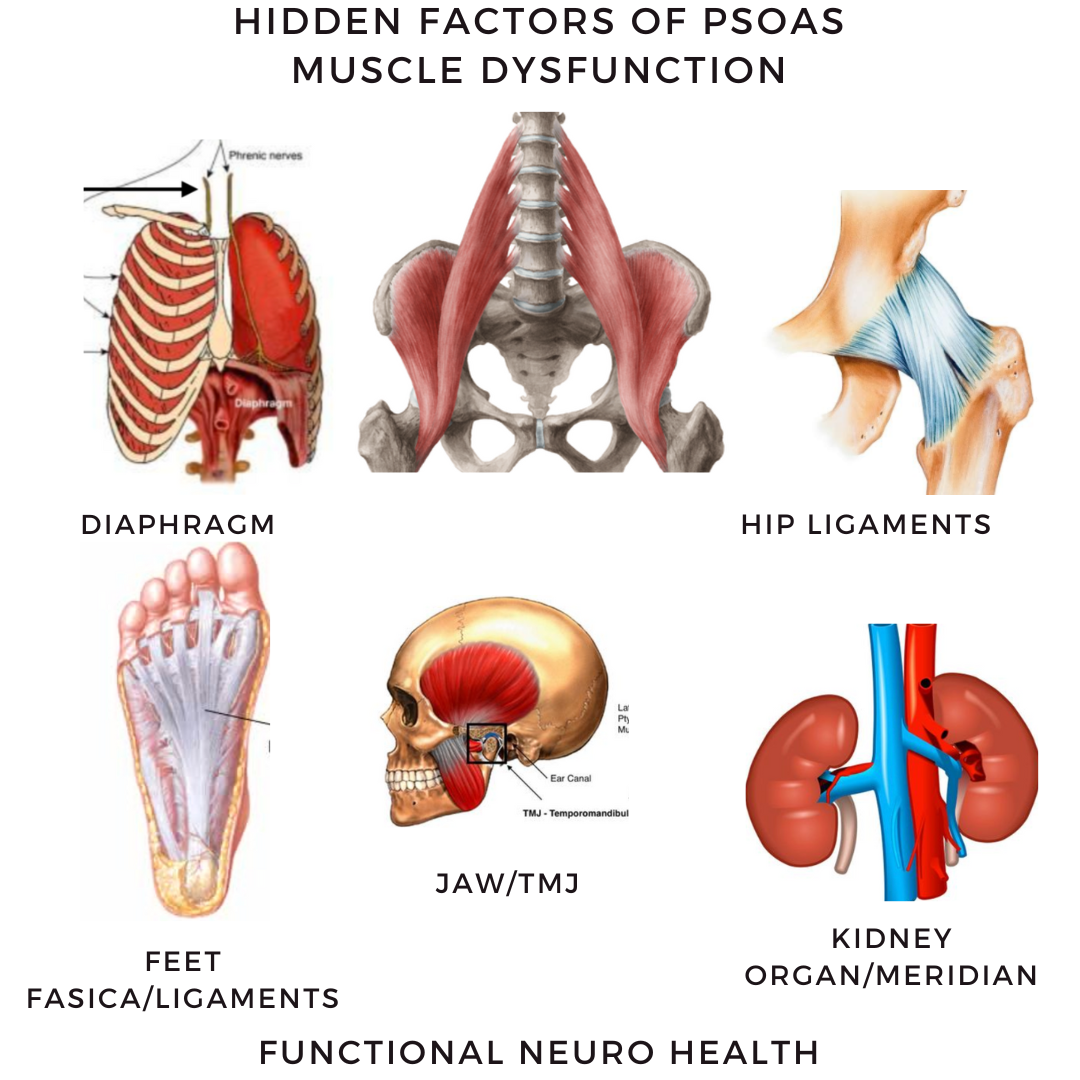
Visceral reflexes: kidney or adrenal stress weakens it via organ-muscle somatic loops.
-
Joint dysfunction: hip, SIJ, or lumbar joints send distress signals that inhibit it.
-
Emotional guarding: trauma and startle reflex patterns recruit it to brace.
The lumbar plexus itself — L1–L3 ventral rami — is embedded inside the psoas. That makes it a neurological hub, not just a mover. If the system is under threat, the psoas will be one of the first places you’ll see it.
Breath and the Diaphragm: A Tethered Pair
The psoas has an intimate relationship with the diaphragm. The crura of the diaphragm attach to the same upper lumbar vertebrae where the psoas originates. The fascia of the two muscles blends, forming a continuous myofascial bridge.
Every breath is a conversation between diaphragm and psoas.
-
On inhalation, as the diaphragm contracts downward, the psoas stabilises the lumbar spine from the front.
-
On exhalation, the psoas should soften, allowing the diaphragm to fully ascend.
When stress alters breathing, the psoas is pulled with it. High-chest breathing and chronic sympathetic tone keep the diaphragm rigid, which keeps the psoas braced. Over time this “threat loop” wires into the body: anxious mind, tight diaphragm, inhibited psoas.
This is why psoas work often feels like an emotional release. Free the diaphragm, free the psoas. Free the psoas, free the breath.
